The brief
C&C Milano is one of the most recognisable names in high-end Italian textiles: linen, cotton, embroidery, a manufacturing tradition counted in decades. For Milan Design Week 2026 the brief had a contradiction built in: tell the story of fabrics you understand by touching them, inside a technology installation, without the technology swallowing the atelier.
The setting was SuperNova at Superstudio Più, under the title Ideas between Tradition and Future. C&C Milano, an Official Partner of Superstudio, wanted a space where visitors would not look at a swatch book but compose a room with their own hands, and leaf through the atelier's history like a book.
What we built
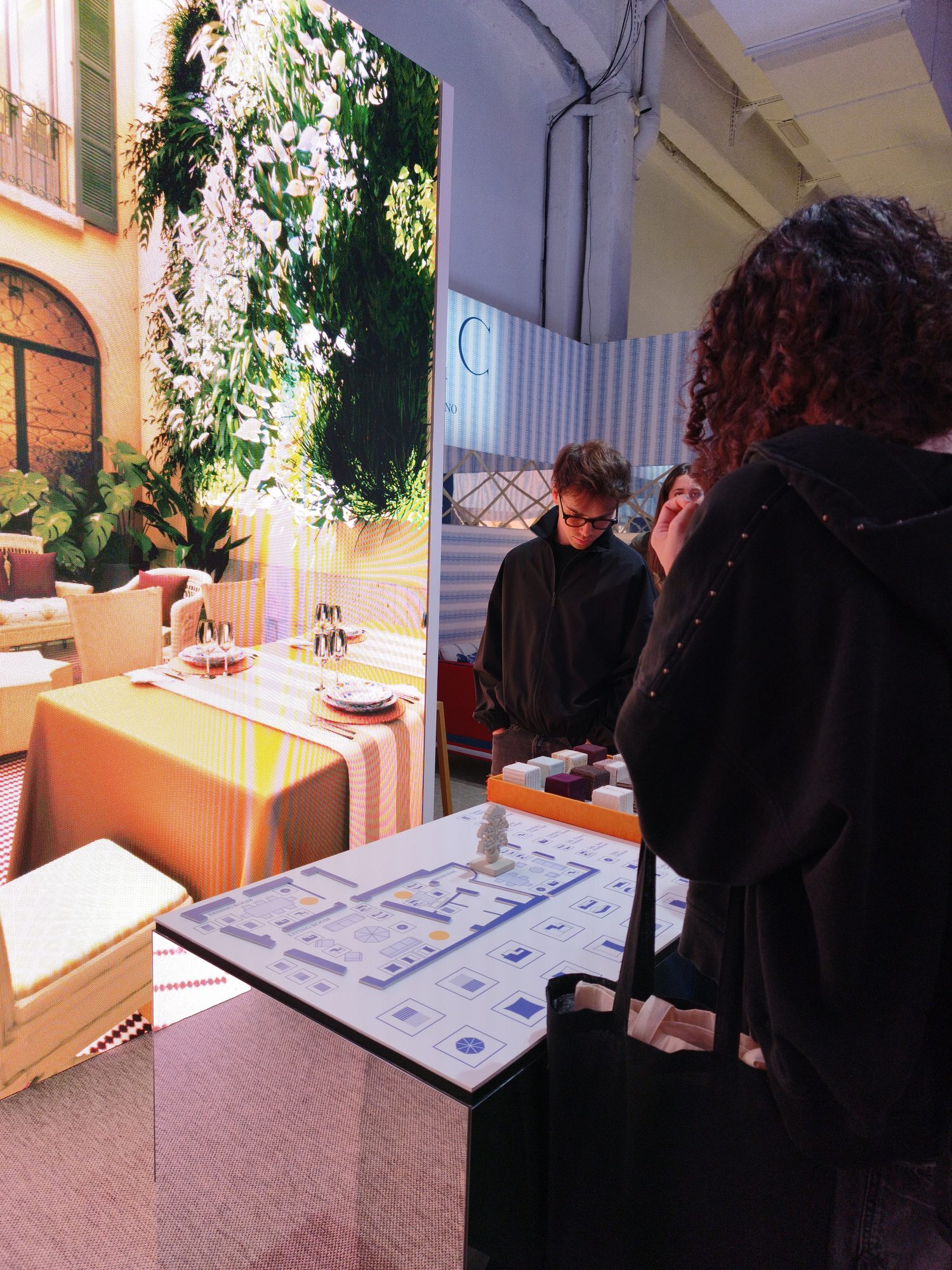
The Tactile Atelier is a phygital installation made of three pieces that talk to each other in real time.
The backdrop is a large LED wall running a photorealistic 3D scene in Unreal Engine: the rooms of the apartment at via Brera 7, C&C Milano's historic showroom. Walls, sofas, curtains and cushions have parametric materials that switch fabric on the fly, under physically correct lighting, so drape, weave, reflections and shadows are what the fabric would do in the real room.
At the centre is the Phygimat, the interactive table we designed and built. On it, a set of cubes covered in C&C Milano fabrics; the cores are 3D printed in our Fabrication Lab, in filament or resin depending on the part. Inside each cube is an invisible marker. You set a cube on the "wall", "curtain", "sofa" or "cushion" slot and the fabric appears on the matching surface on the LED wall, at full scale, immediately. The visitor furnishes via Brera by hand and sees the result behind them.
Next to the table, a station with an interactive digital book about the brand: history, collections, manufacturing processes, macro shots of the fabrics. You turn the pages with a gesture and it is laid out like an author's monograph.
"When digital reality surpasses imagination." (AT Superstudio Magazine, SuperNova 2026 edition)
How it works
The scene runs in Unreal Engine with PBR materials and real-time lighting on a dedicated stage PC that feeds the LED wall. A reader built into the table top reads the cubes; the fabric-to-surface table is managed by the application and material changes reach the scene over the local network. Less than 50 milliseconds pass from the cube touching the table to the pixel on the LED wall.
The virtual book is a touch application built on our editorial framework, with high-resolution assets and content kept separate from presentation logic: the C&C Milano team updates it on their own.
Table, reading electronics and fabric tokens, printed cores included, came out of our Fabrication Lab. The physical LED wall was supplied and installed by another vendor: our scope is the scene running on it and the system driving it.
How it went
The Tactile Atelier was among the most shared installations of SuperNova 2026, on social media and in the trade press. Visitors stayed at the stand far longer than average, touched the fabrics, composed their own versions of the apartment and left knowing how those materials sit in a room.
The format is now a product: the Phygimat and the Interactive Virtual Book are two independent capabilities of the Surface vertical, configurable for any brand that needs to tell a story of material, configuration or heritage.
Accessibility
A tangible interface is already, in itself, an accessibility principle: when information travels through touch and handling, the experience no longer depends on sight alone. It is the same principle behind tactile stations in accessible museums.
We designed the installation to WCAG 2.1 AA and the European EN 301 549 standard, with touch among the primary channels. The same information arrives visually (the LED wall), tactilely (the cubes) and in text (the book), and no single sense is a prerequisite. You grab and place an object, with no fine gestures or touchscreen precision, so it works for people with motor or cognitive limitations too. Placement areas are wide, recognition is under 50 ms and visual feedback confirms every action. In the virtual book, contrast meets level AA, type is scalable and no information relies on colour alone; the language is plain and the structure predictable.
Touch, here, is a way to let more people into the same experience.